ConciseTravel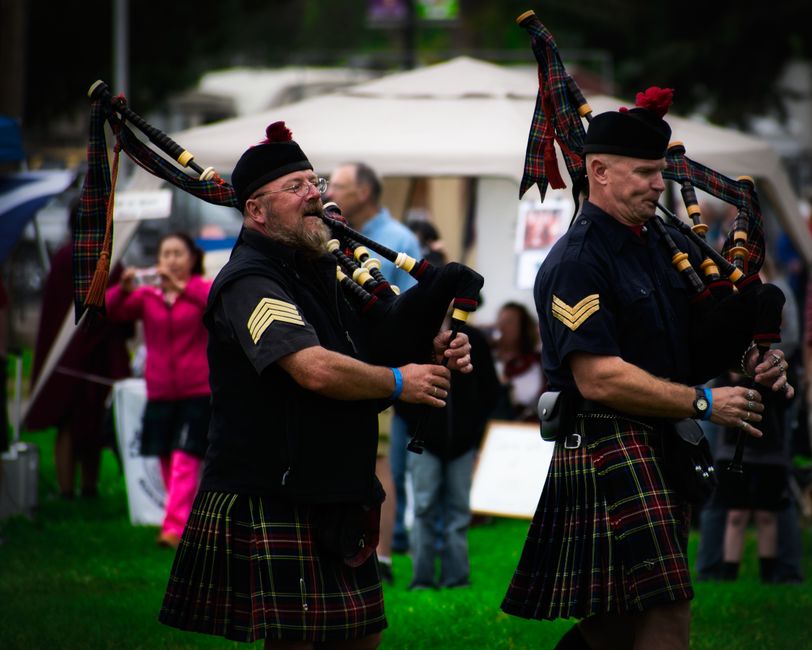
The Scottish Highlands has a year-round calendar of events that range from genuinely ancient traditions to relatively modern music festivals that happen to take place in extraordinary locations. Planning your visit around one of these can transform a good Highland trip into a memorable one.
Highland Games: The Real Deal
Highland Games take place across the Highlands and Islands throughout the summer, typically from May to September. These are not tourist productions. They are living community events that have existed in some form for centuries, combining athletic competition, piping, and dancing.
The athletic events:
Caber tossing: A caber is a large tapered pole, typically 5 to 6 metres long and weighing around 80 kg. Competitors lift it vertically, run forward, and attempt to flip it so it lands with the narrow end pointing away and the rotation at 12 o'clock. Distance is not the point; accuracy of the flip is scored.
Hammer throw: Swinging a metal ball on a handle and throwing it for distance. Similar to Olympic hammer throw but using a different technique.
Stone put: Similar to shot put but using a heavy stone, an event that predates the modern Olympic version.
Weight throw: Two versions: for distance and for height over a bar. Impressive.
Tug of war: Teams, straightforward, reliably entertaining.
The competitions are serious but the atmosphere is relaxed. Spectators wander the arena, families picnic on the grass, and pipe bands perform throughout. Visitors are sometimes invited to try lighter versions of the events.
Where to go:
Braemar Gathering (first Saturday of September, near Balmoral): the most famous, attended by the royal family and booking out early. Book very far in advance.
Inveraray Highland Games (July): on the shores of Loch Fyne, an atmospheric setting.
Invergordon Highland Games and Dornoch Highland Games (both summer): more local in character, less tourist density.
Portree Highland Games on Skye (August): compact, accessible, good for first-timers.
Almost every Highland town of any size has its own games at some point in the summer. Check the local tourist board or event listings for the specific town you are visiting.
HebCelt: The Hebridean Celtic Festival
HebCelt (the Hebridean Celtic Festival) takes place in Stornoway on the Isle of Lewis each July. It runs over four days and combines well-known folk and Celtic acts with Gaelic performers, local bands, and an atmosphere that can only exist in a small island town taking over its castle grounds for a music festival.
The headliners have included names like Runrig, Capercaillie, The Chieftains, and various mainland folk acts. The support programme includes traditional Gaelic singing, céilidh dancing, and performances by youth groups.
The festival is outdoors, on the grass around Lews Castle. It rains. Everyone goes anyway, in waterproofs. The atmosphere is genuinely warm in a way that larger mainland festivals often are not.
Stornoway accommodation books out for HebCelt. Campervans and tents are common. Plan months ahead.
Up Helly Aa: January's Viking Fire Festival
Up Helly Aa is held in Lerwick, Shetland, on the last Tuesday of January. It is the largest fire festival in Europe and one of the most visually extraordinary events in Britain.
The format: a torchlit procession of up to 1,000 guizers (participants) in full Viking warrior costume, led by the Jarl's Squad in authentic Viking dress. The procession marches through Lerwick to a designated site where a replica Viking longship has been constructed. The Jarl makes a speech. The guizers encircle the longship with lit torches. On signal, all torches are thrown. The longship burns.
Lerwick then celebrates through the night in a series of halls visited by the guizer squads, each performing a skit or sketch. It continues until dawn.
Up Helly Aa commemorates Shetland's Norse heritage and has been held since the 1880s in its current form. The event is community-run and local in character: it is not designed for tourists, but visitors are welcome.
How to see it: Accommodation in Lerwick in the last week of January is limited and books early. The procession route is public and free to watch. Hall tickets for the evening festivities are allocated to local residents and are extremely difficult for visitors to obtain. Most visitors watch the torchlight procession and the longship burning, which is the core spectacle.
Loganair flies to Lerwick (Sumburgh Airport) from Aberdeen, Inverness, Edinburgh, and several other UK airports.
St Magnus International Festival (Orkney)
The St Magnus International Festival takes place in Orkney in June, founded by composer Peter Maxwell Davies. It is a classical music and arts festival using Orkney's extraordinary prehistoric and Norse settings as venues: St Magnus Cathedral in Kirkwall, and sometimes outdoor sites.
The programming is serious and high quality. An unusual combination of professional classical music at world-class level in a small island setting.
Blas Festival
Blas (meaning taste in Gaelic) takes place across the Highlands and Islands in September, celebrating Gaelic culture through music, song, and events in multiple venues simultaneously across the region. It is more diffuse than a single-site festival: events happen in village halls, pubs, and community centres across a wide area. The effect is of encountering Gaelic culture in its natural habitat rather than in a tourist presentation.