 ConciseTravel
What Makes the Lake District Actually Special
England has 15 national parks. The Lake District gets the crowd. That's not an accident.
At around 2,362 km², it's the largest national park in England, and in 2017 it became a UNESCO World Heritage Site — recognised not just for its landscape but for the rare combination of natural beauty and centuries of human culture layered on top of each other. That's the key thing to understand before you arrive: this isn't just pretty scenery. It's scenery with a story.
The fells were carved by glaciers. The farms were built by Norse settlers (those "-thwaite" and "-dale" place names are Viking). The poets came next, then the Victorians on their new railway, then the walkers, then the Instagram accounts. Every era left something behind, and somehow it all holds together.
The Literary Connection
The Lake District produced the Romantic movement in English literature. William Wordsworth didn't just visit — he was born here, lived here most of his life, and called Grasmere "the loveliest spot that man hath ever found." He wasn't wrong, but he was also biased.
Beatrix Potter came later, bought farms, bred sheep, and eventually left 4,000 acres to the National Trust. Her legacy isn't just Peter Rabbit: it's a significant portion of the preserved landscape you'll walk through today.
Dove Cottage in Grasmere (Wordsworth's home) and Hill Top Farm near Hawkshead (Potter's creative base) are two of the most visited literary sites in Britain. They're worth your time not as museum pieces but as genuine windows into why this place inspired people so deeply.
The Geography (and Why the Weather Is Part of It)
Sixteen major bodies of water, England's highest peaks, and a climate famously described as "moist." Glaciers did the heavy lifting at the end of the Ice Age, scooping out the valleys and leaving behind ribbon lakes, tarns, and the rounded fells that define the skyline.
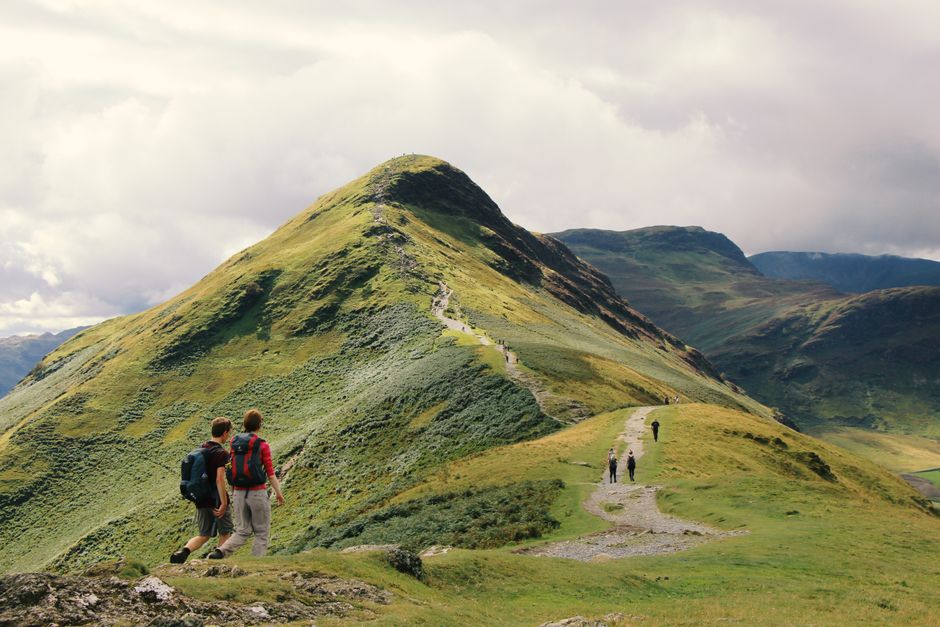
Scafell Pike at 978 metres is England's highest mountain. Helvellyn at 950 metres is arguably more dramatic. And Catbells, at a more modest 451 metres, is probably the one most people actually finish.
The weather is the part nobody warns you about strongly enough. Around 200 rainy days a year. Sudden shifts from sunshine to fog to downpour within a single afternoon. This isn't a bug — it's what keeps the landscape green, keeps the crowds slightly lower than they'd otherwise be, and gives you great stories to tell when you get home. Pack a waterproof. Pack a proper one, not a fashion one.
The Herdwick Sheep Situation
They're everywhere, they look grumpy, and they're kind of iconic. Herdwick sheep are native to the high fells and have been here for centuries. They're hardy, they're territorial (they'll return to their own fell if moved), and they were central to Beatrix Potter's conservation work.
They're also one of the reasons the landscape looks the way it does — generations of grazing have shaped the open hillsides. Locals are quietly proud of them. You should be too.
A Genuinely Useful Note on Scale
First-timers often underestimate how spread out the Lake District is. The popular lakes and towns cluster in the central and northern areas, but the western valleys — Wasdale, Ennerdale, the Duddon Valley — are a different world: quieter, wilder, and often overlooked. If you have more than three days, go west.
The paid ConciseTravel Lake District guide covers which areas suit different trip styles, what to prioritise based on your interests, and the logistics of getting between the highlights efficiently.