ConciseTravel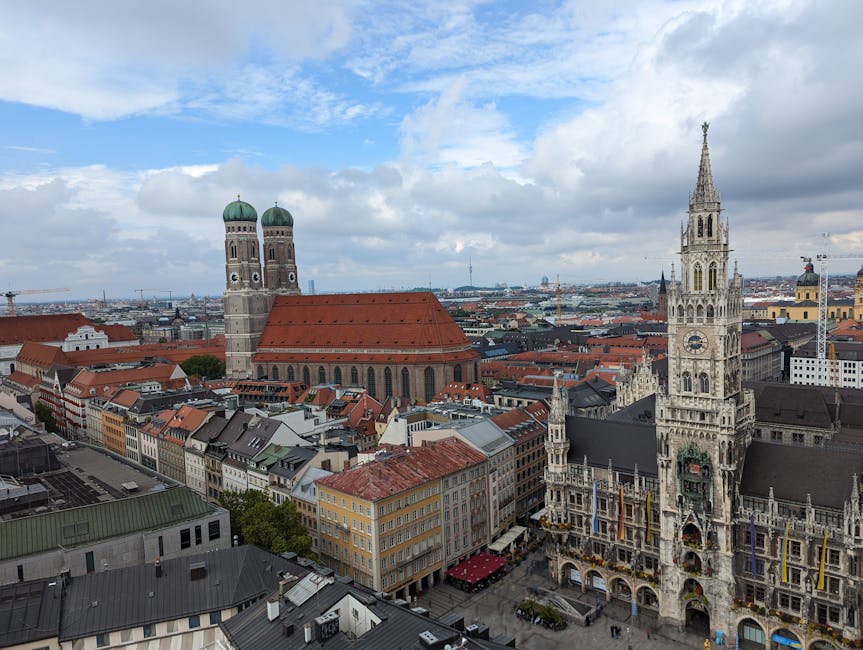
Munich tends to get filed under "expensive German city," and the beer halls and boutique hotels don't exactly push back on that. But the free offer is stronger than most visitors realise. Here's what we'd make time for.
English Garden (Englischer Garten)
One of the largest urban parks in the world, bigger than Central Park, and entirely free. You can spend an entire day here: walking the formal gardens near the Haus der Kunst, cycling the paths north into the wilder sections, watching surfers ride the standing wave at the Eisbach (the river channel near the southern entrance), and stopping at one of the beer gardens, where you can bring your own food even if you're buying drinks. The Chinese Tower beer garden is the most famous; the Hirschau, further north, is calmer.
The Eisbach Wave
Worth singling out from the English Garden because it's one of Munich's genuinely unusual sights. A standing wave on an urban river channel, where surfers queue to ride it in the middle of the city. Free to watch, free to try if you have a board and the skills. It runs year-round.
Marienplatz and the Glockenspiel
The central square is free to stand in and watch. The Glockenspiel on the Neues Rathaus (New Town Hall) performs daily at 11:00, 12:00, and 17:00 (March to October), with mechanical figures re-enacting scenes from Munich's history. The building itself is a dramatic piece of neo-Gothic architecture. The Altes Rathaus (Old Town Hall) at the other end of the square is quieter but older and arguably more interesting.
Viktualienmarkt
Munich's permanent food market, a short walk from Marienplatz, is free to walk through. It's been running continuously since 1807 and the stalls selling cheese, meat, bread, flowers, and Bavarian specialities make for genuinely enjoyable browsing.Don't confuse this with a tourist trap — locals shop here.
Free Museum Sundays (First Sunday of the Month)
Several of Munich's state museums offer free entry on the first Sunday of each month. These include the Deutsches Museum (science and technology — one of the best in the world), the Alte Pinakothek (old masters from Dürer to Rubens), the Neue Pinakothek (19th-century European art), the Pinakothek der Moderne (design, architecture, and modern art), the Bayerisches Nationalmuseum, and the Museum Brandhorst. This is genuinely exceptional value. The trade-off: these Sundays get busy, especially at the Deutsches Museum. Go early.
Hofgarten
The formal court garden adjacent to the Residenz palace, with a circular temple at its centre. Free to enter and a pleasant place to walk, particularly in spring and autumn. On summer evenings, people gather at the central Diana Temple to play music.
The Residenz (Exterior)
Munich's royal palace takes up a large block in the city centre. Entry to the museum inside requires a ticket, but the exterior and the Max-Joseph-Platz square in front of it are free. The Feldherrnhalle on Odeonsplatz nearby — a 19th-century loggia modelled on the Loggia dei Lanzi in Florence — is also free to visit.
Nymphenburg Palace Grounds
The palace buildings at Nymphenburg charge admission, but the formal gardens and the extensive parkland behind them are free and open year-round. The canal running from the palace, the formal parterres, and the wilder English landscape garden beyond make for a long, varied walk. Several kilometres of paths in total.
Olympiapark
Built for the 1972 Olympics, the park is free to enter and walk around. The tent-roofed architecture is still striking, the hill (Olympiaberg, made from WWII rubble) gives good views over the city, and the lake is pleasant. The stadium and tower both charge entry. The park itself is excellent for a free afternoon.
BMW Welt
The BMW showroom and event space adjacent to the Olympiapark is free to enter. It's a striking piece of contemporary architecture and the cars on display are genuinely interesting even if you're not a car person. The double-cone building is one of the more photogenic modern buildings in Munich.
Asamkirche
One of the most ornate Baroque church interiors in Bavaria, built in the 1730s by the Asam brothers as a private chapel. It's tiny, so visits are short, but the interior is extraordinary: gold, marble, frescoes, and trompe-l'oeil from floor to ceiling. Free to enter. On Sendlinger Strasse, a short walk from Marienplatz.
Schleißheim Palace Grounds (Outer Gardens)
A little further out, but the formal Baroque gardens at the New Palace in Schleißheim are free to walk through. The palace interiors charge admission; the parterre gardens do not. Reachable by S-Bahn.