ConciseTravel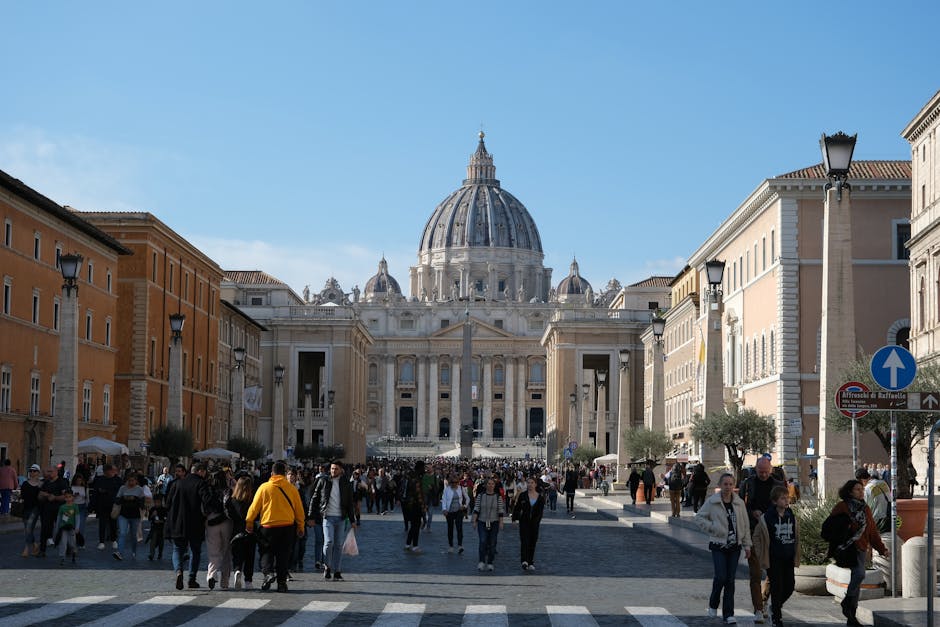
Vatican City is technically a separate country. It has its own postal service, its own guards, and entry rules that Rome's general tourist logic doesn't apply to. Getting this wrong — turning up without a booking, or being turned away at the door for a dress code violation — is a costly mistake given how much of your day it eats.
Here's how to do it properly.
Two Separate Experiences
Most first-timers don't realise that St. Peter's Basilica and the Vatican Museums are distinct, separately accessed sites.
- St. Peter's Basilica: Free to enter, no booking required. Dress code applies.
- Vatican Museums (including the Sistine Chapel): Ticketed, booking essential, dress code applies.
You can do both in a single day, but they require different planning.
The Dress Code (Non-Negotiable)
Both sites enforce the same rule: no bare shoulders, no bare knees. This applies to all genders.
If you turn up in shorts and a sleeveless top, you'll be turned away. Keep a light scarf, sarong, or jacket accessible — not buried in your bag. Enforcement is real, especially in peak season.
St. Peter's Basilica
The largest church in the world by interior volume, St. Peter's is free to enter and genuinely jaw-dropping. The scale becomes clear only once you're inside — the figures in the mosaics that appear person-sized from a distance are actually several metres tall.
Highlights inside:
- Michelangelo's Pietà: Tucked to the right as you enter. The sculpture of Mary holding Christ is behind glass now, following a vandalism incident in 1972, but the detail is still extraordinary.
- The Main Altar and Baldacchino: Bernini's bronze canopy over the papal altar, 29 metres high, took a decade to build. The twisted columns are theatrical even by Baroque standards.
- The Crypt: Below the main floor, accessible for free, contains the tombs of popes including John Paul II.
Dome Climb: For a modest fee (~€8 with lift, €6 without), you can climb to the top of Michelangelo's dome. The 360-degree view over Vatican City and Rome is excellent. Be aware the final stretch is a narrow, slightly tilted staircase.
Expect queues on peak days, but they move faster than the Vatican Museums queue. Arriving early (doors open at 7am for Masses, general tourist entry slightly later) is the cleanest option.
The Vatican Museums
The Vatican Museums contain one of the most significant art collections in the world — accumulated over centuries of papal patronage. They're also genuinely exhausting to navigate. The complex covers roughly 54 galleries and several kilometres of walking.
Book Before You Go
This isn't optional. Without a timed entry ticket from the official Vatican Museums site (museivaticani.va), you join the standby queue. In summer, that queue can mean four hours of waiting in the sun. Timed entry takes you straight to the door.
Book at least a week ahead in high season. Two weeks is safer for popular time slots (mid-morning on weekdays).
What You'll See
The route through the Museums is largely one-directional and builds toward the Sistine Chapel. Key stops along the way:
- Pinecone Courtyard (Cortile della Pigna): The first main outdoor space, anchored by an ancient bronze pinecone. Where you get your bearings.
- Gallery of Maps: A long corridor lined with extraordinary topographic maps of the Italian regions painted in the 1580s. Most visitors walk through too quickly.
- Raphael Rooms (Stanze di Raffaello): Four rooms painted by Raphael for Pope Julius II, including The School of Athens. These alone justify the entry fee.
- The Sistine Chapel: Michelangelo painted the ceiling between 1508 and 1512 while lying on scaffolding. The Last Judgement on the altar wall came later (1536–1541). Photography is prohibited, the ceiling is above you, and the crowds are dense. Take a moment to actually look up rather than at your phone screen.
Half Day vs. Full Day
A focused half day (3–4 hours) covers the Gallery of Maps, Raphael Rooms, and Sistine Chapel. A full day allows you to explore the Egyptian, Etruscan, and classical sculpture collections at something approaching a civilised pace.
Most people find 4 hours is the practical limit before museum fatigue sets in.
Castel Sant'Angelo
A 10-minute walk from St. Peter's along the river, Castel Sant'Angelo is worth an afternoon addition. Originally built as a mausoleum for Emperor Hadrian, it was later converted into a fortress and papal refuge — a secret underground tunnel (the Passetto di Borgo) connects it to the Vatican, which popes used to escape during sieges.
The view from the top terrace is one of Rome's better panoramas.
For a timed itinerary that fits the Vatican, Castel Sant'Angelo, and the rest of Prati into a logical day, the Rome Travel Guide on Etsy has the full sequence mapped out.
Master rome in Minutes
Don't waste hours planning. Get our condensed, digital cheat sheet with everything you actually need.
Shop Guide on Etsy →