 ConciseTravel
Budapest's public transport system is one of Europe's best-kept secrets. It's cheap, frequent, and actually makes sense—unlike some capital cities I could mention. The metro is fast, the trams are charming, and the buses go everywhere. Once you've got the hang of it, you'll be moving around the city like you own the place.
The Metro: Three Lines, Infinite Possibilities
The Budapest metro has three lines, colour-coded like a civilised country:
M1 (Yellow): Runs from Vorosmarty tér (city centre) southwest through District VII. It's the oldest line (1896, still beautiful), shallow, and honestly a bit of a tourist attraction in itself. All stations are authentic, ornate, and Instagram-worthy.
M2 (Red): The workhorse. Runs north-south across Buda and Pest, hitting Deák Ferenc tér (the main interchange), Astoria, Blaha Lujza tér, and Örs vezér tere. This is your best bet for getting across the river.
M3 (Blue): Runs through eastern Pest, useful for outer neighbourhoods but less essential for visitors.
All three lines converge at Deák Ferenc tér. This is your north star. If you're ever lost, get to Deák and reorient.
Trains run every 3-5 minutes during peak hours, every 5-10 minutes off-peak. Night service exists on weekends (lines 4M and 6M run 24-hours on Fridays and Saturdays). A single ticket is 350 HUF (€1.10); a 10-ticket carnet is 3,000 HUF (€10), which is what you actually want. Journey times are printed at every station.
Trams: The Scenic Route
Budapest's tram network is vast and nostalgic. You've got 30-odd lines crisscrossing Pest and the Buda waterfront. Here's the thing: trams are slower than the metro but they're beautiful, and they take you places the metro doesn't.
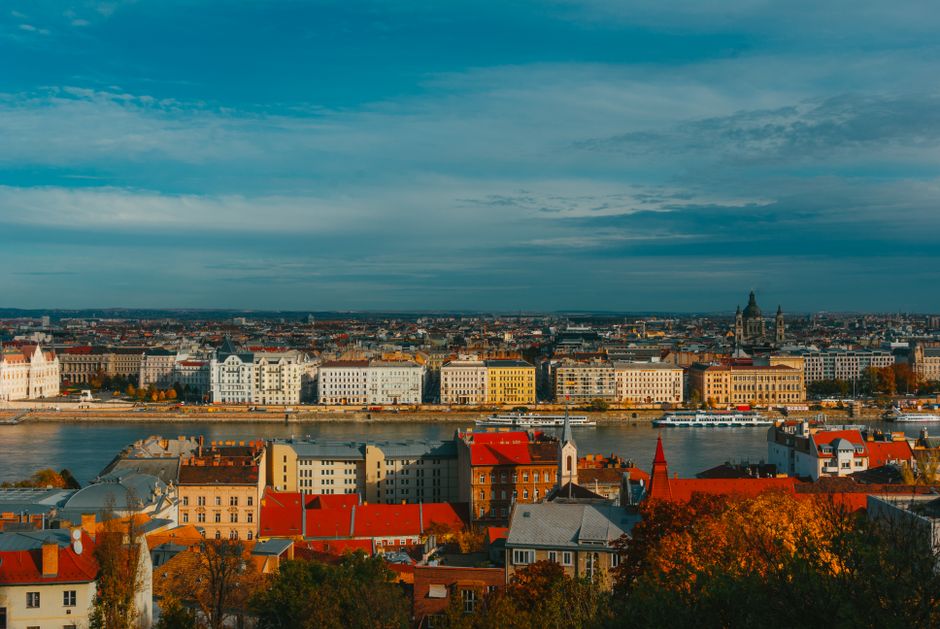
Tram #2 is the sightseeing line—runs along the Danube waterfront with unobstructed views of Parliament, the Fisherman's Bastion, and Margaret Island. If you've got 30 minutes to waste (in the best way), ride it end-to-end.
Trams #4 and #6 circle the outer ring of the city—good for orientation if you're trying to understand Budapest's geography.
Tram #19 goes up to the castle district (Buda side), which saves you a steep walk.
Frequency is every 3-10 minutes depending on the line and time of day. Single ticket is the same as the metro (350 HUF). Night trams run all night (weekends and some weekdays).
Buses: The Reach You Need
Buses go everywhere the metro and trams don't. There are 200+ lines, which sounds overwhelming until you realise you'll only use about five. Buses are numbered 1-299; routes beginning with 9 are night buses.
You don't need to know which buses do what in advance. Download the BKK app (free, offline maps included), plug in your destination, and it'll tell you exactly which bus, when, and how long. Simple.
Buses run every 5-15 minutes on main routes, longer intervals on outer routes. Night buses run all night. Same ticket structure: 350 HUF per journey or a 10-ticket carnet.
How to Actually Pay (The Cards Matter)
You can't just hop on without a ticket. Inspectors board randomly, and fines are steep (8,500 HUF, about €28, no mercy for tourists).
Best option: Get a Navi Card. It's a rechargeable contactless card you buy at any metro station (1,500 HUF, which includes 500 HUF credit). Then load money onto it. A single journey costs 350 HUF. It's fast, it's used everywhere, and you don't waste time hunting for tickets.
Tourist pass alternative: A 24-hour pass is 1,850 HUF, a 72-hour pass is 4,150 HUF. If you're here for more than a week, just get the Navi Card and load money as you go.
Paper tickets: You can buy individual paper tickets from machines at metro stations (cash or card) or from some kiosks. They're the same price but more faff. Each ticket is single-use; you validate it by touching it to the readers on poles inside the vehicle.
The App That Actually Works
BKK Futár is Budapest's official transport app. Download it before you arrive. It's free, it works offline, and it shows:
- Real-time vehicle locations
- Exact arrival times
- Transfer suggestions (fastest route or fewest changes)
- Disruptions and delays
- Journey planning for future trips
The interface is in Hungarian by default, but you can switch languages in settings. The UX is solid. You'll use this daily.
Rules of the Road (Survival Tips)
Validate your ticket. When you board, touch your Navi card or paper ticket to the readers on the poles. If you don't validate, you've technically got no proof of payment, and inspectors are harsh.
Stand to the right on escalators. Yes, really. Budapesters are efficient about this.
Don't eat on public transport. You can drink water, but actual food is frowned upon. No one will arrest you, but you'll get looks.
Peak hours are 7-9am and 4-6:30pm weekdays. Everything's rammed. Your personal space will be a theoretical concept.
Beggars sometimes board trains. They're harmless. Ignore them, don't make eye contact, and they'll move on. It's a cultural thing, not a safety issue.
Night buses and trams are safe. Budapest doesn't have the sketchy-transport problem some cities do. Still, sit in lit areas if you're alone at 2am, but you'll be fine.
Monthly Pass and Longer Stays
If you're staying more than a week, get a monthly pass. It's 9,500 HUF (about €32) and works on metro, tram, and bus. Unlimited travel, valid for a calendar month. Buy it at any metro station or BKK ticket window.
Getting Lost (And Finding Your Way Back)
Budapest's transport is logical enough that you won't stay lost. Every metro station has big, readable signs. Trams and buses have route numbers plastered on the side. The BKK app will recalculate your route in real-time if you get on the wrong vehicle.
My best advice: spend your first day just riding the metro and trams. Get a feel for how the city's laid out. Ride Tram #2 end-to-end and you'll understand Budapest's geography in 45 minutes.
Master Budapest in Minutes
Don't waste hours planning. Get our condensed, digital cheat sheet with everything you actually need.
Shop Guide on Etsy →