 ConciseTravel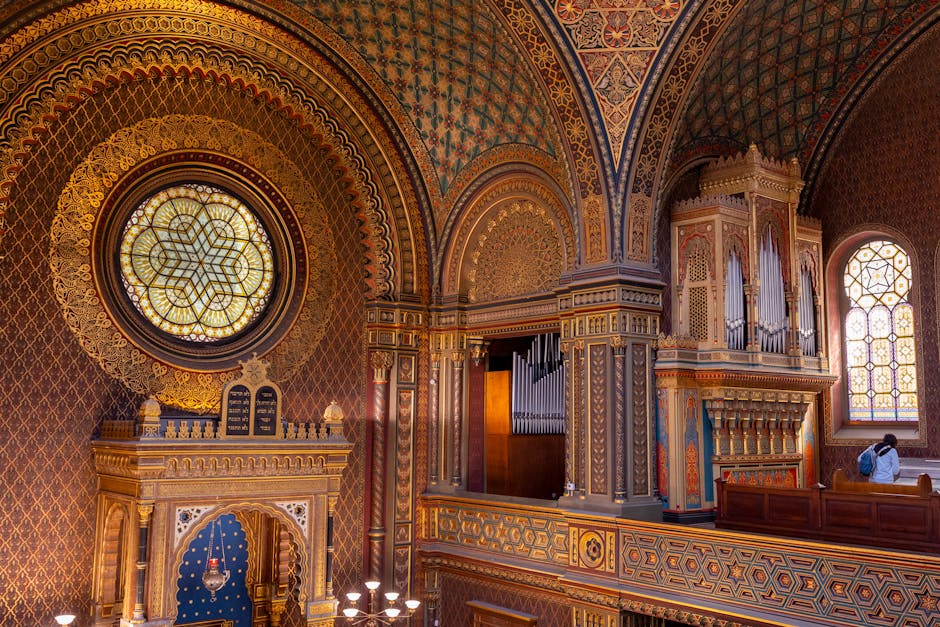
Jewish heritage sites in Europe are among the most historically significant places on the continent, and they carry the weight of that history in ways that purely tourist attractions do not. These cities have the most concentrated and accessible Jewish heritage in Europe, and each rewards a thoughtful visit.
The Cities
Prague
Prague's Jewish Quarter, Josefov, contains one of the most complete surviving concentrations of pre-Holocaust Jewish heritage in Europe. Six synagogues remain intact, including the Old-New Synagogue (the oldest active synagogue in Europe, dating to the 13th century) and the Spanish Synagogue, whose Moorish Revival interior is extraordinary. The Old Jewish Cemetery, where gravestones are layered 12 deep due to the space constraints of the medieval ghetto, is among the most affecting sites in the city. All six synagogues and the cemetery operate as a unified museum complex with a single combined ticket. The proximity and density of the sites makes Josefov one of the most rewarding half-days in Prague.
Best for: travellers who want the most concentrated surviving Jewish heritage in Central Europe, with significant pre-war history and context provided throughout.
Kraków
Kraków's Kazimierz district was the Jewish quarter of the city for over 500 years and survived the war with much of its architecture intact, in contrast to the communities it once housed. The Galicia Jewish Museum provides essential context: it documents the traces of Jewish life remaining in the Galicia region rather than focusing only on the Holocaust. The Old Synagogue (now a museum), the Remuh Synagogue (still active), and the Remuh Cemetery are the anchors of the quarter. Schindler's Factory, across the river in Podgórze, is a significant additional site. Kazimierz has become heavily gentrified and commercialised in parts, which warrants some navigation care.
Best for: travellers combining Jewish heritage with broader Polish history, and willing to engage with difficult recent history in depth.
Amsterdam
Amsterdam's Portuguese Synagogue (Esnoga) is one of the most beautiful synagogues in the world: a 17th-century building of extraordinary proportions, lit entirely by candles, still in use by the Sephardic Jewish community that built it. The Jewish Historical Museum adjacent to it covers four centuries of Jewish life in the Netherlands with depth and care. The Dutch Jewish community was disproportionately devastated during the occupation (the highest proportion of any Western European country), and the Anne Frank House on Prinsengracht contextualises that history through a specific and human story. These three sites form a coherent heritage circuit.
Best for: travellers who want to combine architectural significance (the Portuguese Synagogue is exceptional) with serious historical context across multiple sites in a compact area.
Vienna
Vienna's Jewish heritage reflects the history of one of the most significant Jewish communities in Central Europe before the 20th century. The Judenplatz memorial, designed by Rachel Whiteread, is a cast of a library with its books turned outward: a deliberate absence as a form of memorial. The Stadtempel synagogue (the only Viennese synagogue to survive Kristallnacht, because its interior position protected it from arson) is open for guided visits. The Jewish Museum Vienna has two locations covering the medieval and modern periods. The Museum on Judenplatz focuses specifically on the medieval Jewish community destroyed in the 15th century.
Best for: travellers who want to engage with both the medieval and modern history of a major Central European Jewish community, with a significant contemporary memorial at the centre.
Thessaloniki
Thessaloniki had one of the largest and most historically important Sephardic Jewish communities in the world before 1943, when the majority of the city's Jewish population was deported. The Jewish Museum of Thessaloniki on Agiou Mina Street is the primary institution for this history. The surviving synagogues are few, and the community is small, but the scale of what was lost is part of what makes Thessaloniki significant: this was a city where Jews formed the majority of the population for centuries, where Ladino was spoken in the streets, and where the Sabbath effectively shut down the port. The museum makes that world visible.
Best for: travellers who want to understand the Sephardic Jewish tradition in Europe, specifically the communities who settled in the Ottoman Empire after expulsion from Spain in 1492.